
https://hubpay.io/
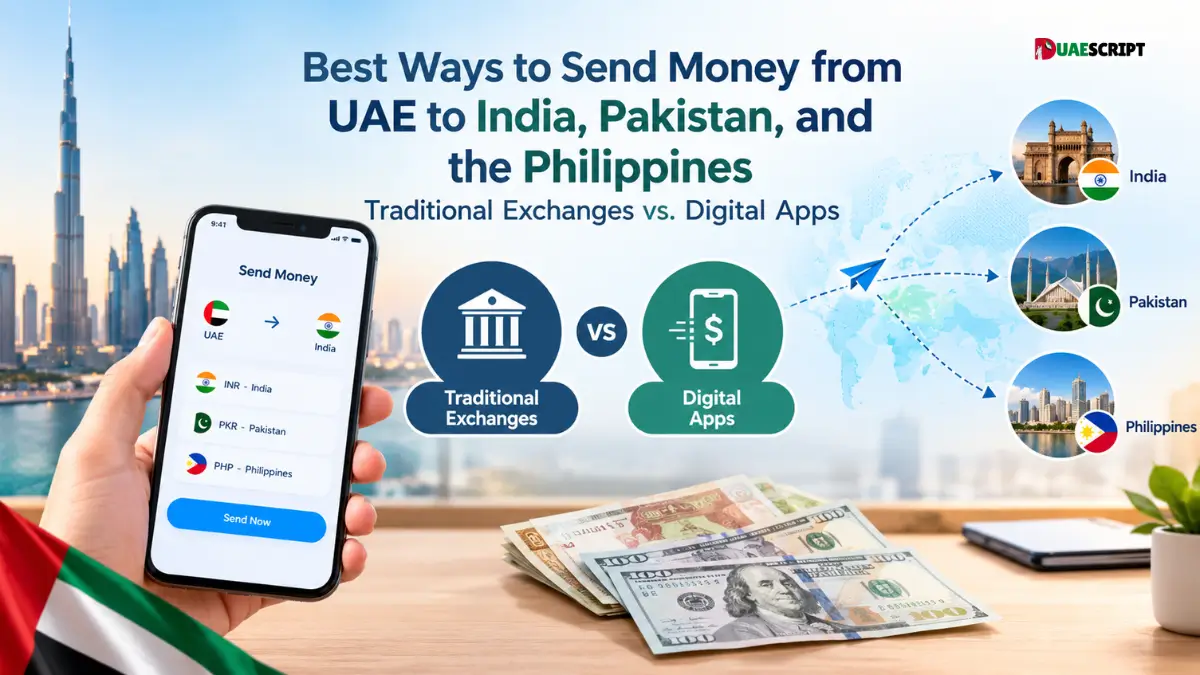
If you live and work in the UAE, the end of the month almost always looks the same: your salary hits, you look at your budget, and you send a chunk of your earnings back home. For millions of expats across Dubai, Abu Dhabi, and Sharjah, sending money to families in India, Pakistan, or the Philippines is not just an errand—it covers school terms, medical prescriptions, grocery runs, and mortgages.
For decades, the standard routine was simple, if exhausting: you withdrew cash, walked into an exchange branch in Satwa, Deira, or a local mall, took a paper ticket, and waited in line.
Over the last few years, the game has shifted. Apps like Hubpay and Botim Pay now let you send money directly from your couch, while legacy giants like Al Ansari and LuLu have modernized their own digital apps alongside their massive branch networks.
The big question remains: Which service actually leaves your family with the most cash in their hands, without hidden catches or unnecessary hassle?
Let’s unpack how these channels work in the real world, how pricing genuinely functions, and where you should route your money based on where it needs to land.
The True Cost of Remittance: Upfront Fees vs. Hidden Rate Markups
Most people glance at an advertisement that says “AED 0 Transfer Fee!” and assume they’re getting a bargain. In cross-border finance, there is rarely such a thing as a free lunch.
Whenever you send money across borders, two costs determine the final payout:
-
The Stated Transfer Fee: A flat administrative charge, typically anywhere from AED 0 to AED 25 depending on the platform, speed, and payout destination.
-
The Exchange Rate Spread: The quiet difference between the real market rate (what you see on Google or financial tickers) and the retail rate the provider quotes you.
A provider waiving upfront fees often makes their profit by shaving 1% to 2% off the conversion rate. On a transfer of AED 500, a zero-fee promo might indeed save you money. But if you’re transferring AED 5,000 to buy land or pay off a car, an unfavorable exchange rate can quietly cost you hundreds of dirhams in missing rupees or pesos—far more than a flat AED 15 counter fee ever would.
-
Quick rule: If you are sending small amounts (under AED 1,000), prioritize low or zero flat fees. If you are sending large sums (over AED 3,000), obsess over the exchange rate. A gap of just a few fils per dirham adds up fast.
The Traditional Giants: Al Ansari Exchange vs. LuLu Exchange
Al Ansari and LuLu are household names in the Emirates. You cannot drive through a commercial street or walk through a mall without seeing their storefronts. Their massive scale brings distinct advantages, along with a few familiar headaches.
Al Ansari Exchange
With more than 250 physical locations, Al Ansari is still the backbone of UAE remittance.
-
Where They Win:
-
Sheer Accessibility: If you get paid in cash, work with a WPS payroll card, or simply prefer handing notes to a human teller, nobody matches their branch footprint.
-
Cash Collection Reach: When sending to rural areas where your relative doesn’t have a local bank branch, Al Ansari’s partnerships with pickup networks (Muthoot in India, Bank of Punjab in Pakistan, Cebuana Lhuillier in the Philippines) are rock-solid.
-
Large Transfers: If you need to move AED 25,000 or more, apps often trigger strict automated freeze filters. A physical branch teller can look over your paperwork on the spot and push the funds through safely.
-
-
The Drawbacks:
-
Branch lines between the 28th and 4th of every month can be brutal.
-
The Al Ansari app is functional, but user verification rules sometimes still push you to a branch to unlock higher tier limits.
-
LuLu Exchange
LuLu Financial Group has built a loyal following, particularly by placing branches right next to LuLu Hypermarkets, turning remittance into an easy stop during the weekly grocery run.
-
Where They Win:
-
Banking Ties: LuLu has spent decades securing direct banking ties across South Asia. Account credits to banks like SBI, HDFC, and Habib Bank Limited (HBL) are generally fast and dependable.
-
In-Person Problem Solving: If an account number has a typo or a beneficiary name doesn’t match government records, having a physical desk to visit saves you from endless back-and-forth automated email tickets.
-
-
The Drawbacks:
-
Rates offered at the physical counter can occasionally differ from the rates on their “LuLu Money” app. You have to check both before handing over your money.
-
Their flat fees on smaller transfers can eat into modest balances compared to lean app-only competitors.
-
The Digital Challengers: Hubpay vs. Botim Pay
Pure digital platforms don’t have mall rents or branch payroll to maintain. Because their overhead is lower, they can often pass those savings to you through better exchange rates.
Hubpay
Hubpay emerged as one of the UAE’s flagship fintechs, licensed by the ADGM Financial Services Regulatory Authority (FSRA) and regulated by the Central Bank of the UAE.
-
How It Operates: You connect your existing UAE bank account directly through the app via official open banking switches or use your debit card to fund a digital wallet.
-
Why People Like It:
-
Transparent fee screens. What you see is what lands in the destination account.
-
Consistently aggressive exchange rates for direct bank and mobile wallet payouts.
-
It completely eliminates queuing. You can send money on a Friday night at 11:00 PM without thinking about branch working hours.
-
-
The Catches: You need an active UAE bank account or debit card, a smartphone, and a valid Emirates ID. It isn’t built for cash-based or unbanked wage earners.
Botim Pay
Botim made its name as the go-to app for internet phone calls to family back home. Astra Tech then built a full financial ecosystem directly into the interface.
-
How It Operates: You load money into your Botim wallet via debit card or bank link, allowing you to send money internationally directly from the chat screen.
-
Why People Like It:
-
No Extra App to Download: Millions of expats already open Botim daily. Sending money from the same place you chat with your spouse or parents removes a layer of friction.
-
Micro-Transfers and Bills: Excellent for smaller, frequent transfers, or paying utility bills directly in India, Pakistan, or the Philippines.
-
Regular Promos: They frequently offer zero-fee campaigns and cashback deals to keep users engaged inside the platform.
-
-
The Catches: If an unexpected verification issue or transfer hold happens, relying on in-app automated support bots can be frustrating when you need urgent answers.
Head-to-Head Comparison
| Feature / Factor | Al Ansari Exchange | LuLu Exchange | Hubpay | Botim Pay |
| How You Send | Branch or Mobile App | Branch or LuLu Money App | Mobile App | Mobile Chat App |
| Typical Fixed Fee | AED 15 – AED 25 | AED 15 – AED 22 | AED 0 – AED 10 (Promo based) | AED 0 – AED 12 |
| FX Spread (Over Market) | 0.6% – 1.8% | 0.7% – 1.8% | 0.4% – 1.2% | 0.5% – 1.5% |
| Payout Speed | Minutes to 24 hrs | Minutes to 24 hrs | Minutes to next day | Minutes to 12 hrs |
| Accepted Payment | Cash, WPS, Debit Card | Cash, WPS, Debit Card | Bank Direct Debit, Card | Botim Wallet, Card |
| Cash Pickup Available? | Yes, extensive | Yes, extensive | Limited partners | Very limited |
| Best For | High value, cash, WPS | Hypermarket stops, high value | Sharp rates, direct bank credit | Quick transfers, daily users |
Destination Breakdown: India, Pakistan, and the Philippines
Sending money isn’t identical across borders. Payment systems, government incentives, and recipient habits differ significantly in each country.
Corridor Routing Summary
| Destination | Local Currency | Standard Payment Rails | Quickest Payout Method | Best Option |
| India | INR | UPI, IMPS, NEFT | Instant Bank Transfer | Hubpay or Botim for everyday amounts; Al Ansari/LuLu for large investments |
| Pakistan | PKR | 1Link, Raast, PRI Scheme | Direct Bank Deposit / Raast | LuLu or Al Ansari (Direct bank accounts or cash pickup counters) |
| Philippines | PHP | InstaPay, GCash, Maya | Mobile E-Wallet | Botim Pay or Hubpay (Straight into GCash/Maya wallets) |
1. UAE to India (INR)
India runs one of the most advanced instant payment ecosystems in the world. Thanks to IMPS and UPI networks, transfers should land within minutes, not days.
-
Our Recommendation: For regular monthly remittances between AED 500 and AED 10,000, Hubpay or Botim Pay consistently beat branch rates on the INR conversion. However, if you are transferring major capital (AED 25,000+) to buy property or deposit into NRE/NRO fixed accounts, stick with an Al Ansari branch or direct bank corridor programs (like Emirates NBD DirectRemit). The paperwork checks prevent painful compliance holds.
2. UAE to Pakistan (PKR)
The State Bank of Pakistan’s Pakistan Remittance Initiative (PRI) helps keep banking transfers affordable, frequently waiving processing fees when you send the equivalent of USD 100 or more through formal rails.
-
Our Recommendation: If your family uses a mainstream bank account (HBL, MCB, Meezan, UBL), LuLu Exchange and Al Ansari have direct clearing pipelines that settle smoothly through Raast or 1Link. If your recipient lives outside a major city and relies on counter collection, physical exchange houses remain essential.
3. UAE to Philippines (PHP)
Mobile wallets dominate the Philippines. While cash pickup centers like Palawan Express and Cebuana Lhuillier are still common, most families now prefer money dropped straight into GCash or Maya.
-
Our Recommendation: Don’t waste money paying for a physical cash collection service if your recipient uses a smartphone. Botim Pay and Hubpay push money directly into GCash accounts in minutes, saving your family a long trip and a wait in line under the sun. If cash collection is mandatory, use an Al Ansari counter.
4 Practical Habits to Save Money on Remittances
-
Calculate the Final Payout, Not the Rate: Ignore the marketing slogans. Open two different apps, type in the exact dirham figure you plan to send, and check the bottom line: How many rupees or pesos will actually land? The provider that puts the highest number in your recipient’s pocket wins.
-
Watch the Calendar and Clock: Global foreign exchange markets pause over the weekend. Between Friday evening and Monday morning, banks and remittance providers often widen their exchange spreads to protect themselves against market shifts. If your transfer isn’t an emergency, send your money between Tuesday and Thursday during active trading hours.
-
Double-Check Names Against Passports: One small spelling mismatch between your app entry and your recipient’s bank account or national ID can lock your money in compliance limbo for days. Take twenty seconds to verify the details before hitting confirm.
-
Keep Your Emirates ID Updated in the App: UAE financial institutions strictly enforce ID expiration dates. If your Emirates ID expires, your remittance app will lock you out without warning. Keep it renewed and re-scanned early.
Frequently Asked Questions
1. Which platform offers the best exchange rate from the UAE?
There is no single permanent winner because rates change throughout the day. In general, digital apps like Hubpay offer better rates for transfers under AED 10,000 because they carry less physical overhead. For sums above AED 15,000, physical exchange houses can sometimes offer custom, negotiable rates at the counter.
2. Is it safe to send money using mobile apps like Hubpay and Botim?
Yes. Both operate under formal regulatory frameworks. Hubpay is licensed by the ADGM Financial Services Regulatory Authority (FSRA) and regulated by the Central Bank of the UAE. Botim’s underlying financial engine (Astra Tech/PayBy) is authorized and audited by the Central Bank of the UAE.
3. How fast does an instant transfer land in an Indian bank account?
Through IMPS or direct clearing routes, money sent from UAE apps or modern exchange systems typically reaches Indian accounts within 5 to 30 minutes. If sent outside regular clearing cycles or flagged for a name verification review, it can take up to 24 hours.
4. What documents do I need to send money from the UAE?
By law, you must present a valid, original physical Emirates ID when visiting any exchange house. For digital apps, you must complete an electronic Know-Your-Customer (e-KYC) check by uploading a clear scan of your Emirates ID and taking a live selfie verification.
5. Why did my family receive less than the exchange rate I saw online?
Online search engines show the mid-market rate—the wholesale price banks use to trade with one another. Consumer providers sell currency at a slightly lower retail rate, keeping the difference as their operating margin. Some overseas receiving banks also charge minor incoming handling fees.
6. Can I send money home if I don’t have a UAE bank account?
Yes. Workers who receive cash wages or hold payroll cards through the Wages Protection System (WPS) can walk into any Al Ansari or LuLu Exchange branch and send funds over the counter with their physical Emirates ID and cash.
7. What is the cheapest way to send money to GCash in the Philippines?
Using a digital service like Botim Pay, Hubpay, or the LuLu Money app to send directly from your bank or card to the GCash wallet is generally cheaper and faster than paying for cash-over-the-counter handling at a physical branch.
8. Do I have to pay VAT on money sent from the UAE?
No VAT is charged on the actual money you send. However, the standard 5% UAE Value Added Tax applies to the provider’s administrative transfer fee (for instance, a 5% VAT on a AED 15 fee comes to AED 0.75).
9. What should I do if a transfer is delayed?
Locate your transaction reference number (such as the MTCN or internal tracking code). For branch transfers, visit the counter or call their helpline so they can check the bank clearing queue. For mobile apps, open the in-app chat support with your transfer ID ready.
10. Can I recall or cancel a transfer after sending it?
If the money has already landed in the recipient’s bank account or mobile wallet via an instant network, the transaction cannot be reversed. Cancellations are only possible if the funds are still pending clearing or waiting to be collected at a physical cash pickup counter.
You May Like to Read:
5 FAB Prepaid Cards in UAE | Features, Uses & Benefits
Magnati Balance Check Online in UAE Complete Guide
Guide to FAB ATM Balance Check | Quick & Easy Steps
Share this article

Written by : Barika Awad
Barika Awad is a writer at UAE Script, sharing insightful content on fashion, lifestyle, and personal style with a focus on practical, elegant ideas.
Follow us
A quick overview of the topics covered in this article.
- The True Cost of Remittance: Upfront Fees vs. Hidden Rate Markups
- The Traditional Giants: Al Ansari Exchange vs. LuLu Exchange
- The Digital Challengers: Hubpay vs. Botim Pay
- Head-to-Head Comparison
- Destination Breakdown: India, Pakistan, and the Philippines
- 4 Practical Habits to Save Money on Remittances
- Frequently Asked Questions
- 1. Which platform offers the best exchange rate from the UAE?
- 2. Is it safe to send money using mobile apps like Hubpay and Botim?
- 3. How fast does an instant transfer land in an Indian bank account?
- 4. What documents do I need to send money from the UAE?
- 5. Why did my family receive less than the exchange rate I saw online?
- 6. Can I send money home if I don’t have a UAE bank account?
- 7. What is the cheapest way to send money to GCash in the Philippines?
- 8. Do I have to pay VAT on money sent from the UAE?
- 9. What should I do if a transfer is delayed?
- 10. Can I recall or cancel a transfer after sending it?
Latest articles
September 22, 2026