
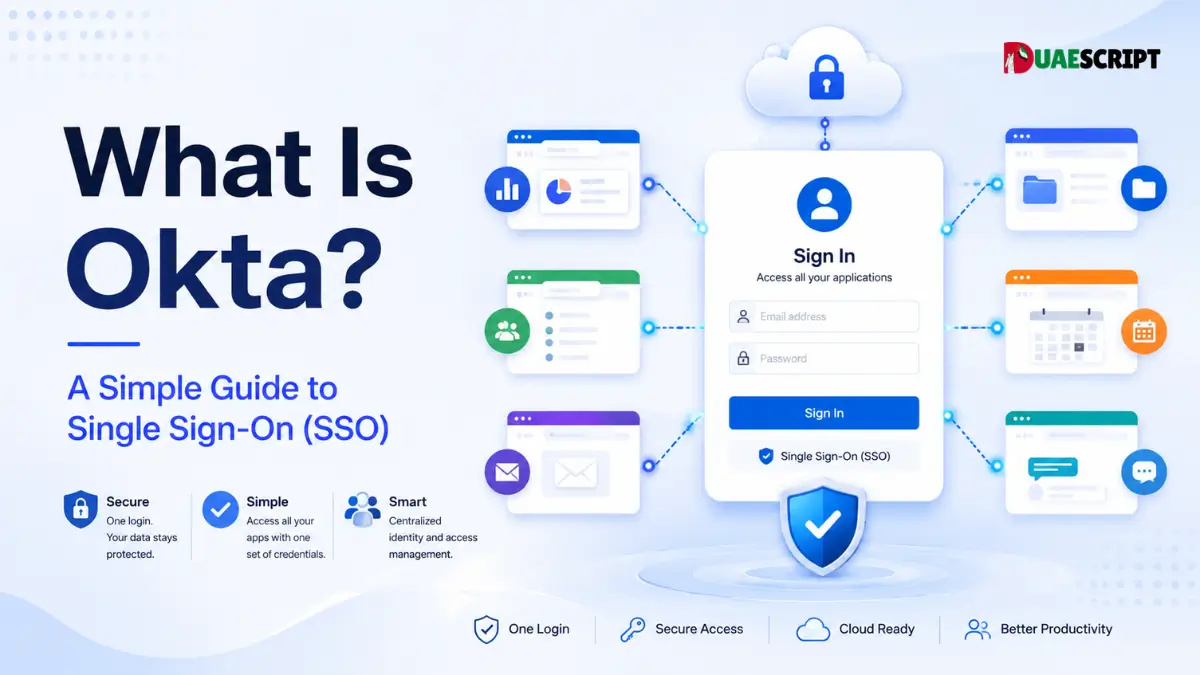
If you’ve ever tried to log into your email at work and noticed that you were automatically logged into Slack or your HR Portal, as well as a myriad of other applications without entering your password again You’ve probably seen Okta in the action. It’s among the most frequently used identity management tools in the world of business but many who use every day use aren’t aware of the purpose behind it. This guide will explain the basics of what Okta is and how single sign-on functions and the reasons why so many businesses use Okta.
The Problem Okta Solves
Consider the number of apps an average employee utilizes at work for calendars, emails and project management software CRM cloud storage tool and an expense management system, perhaps several more. Without a central way to manage access to these tools, each of the applications would require its own user name and password. This means that employees would be having to manage a multitude of passwords, IT teams manually creating and deleting accounts each when someone moves into or leaves the organization as well as security teams waking up because of weak or redundant passwords.
This is exactly the problem access and identity management (IAM) platforms such as Okta were designed to address. Instead of each application managing their own authentication system Okta serves as the central point to verify the identity of who you are and then authenticates the same across every application.
So, What Exactly Is Okta?
Okta is an identity management firm that is cloud-based which provides software that helps businesses manage their access to information securely. access to their data. Since its inception in 2009, it has evolved into one of the top identity providers utilized by companies that range in size ranging from small businesses to large corporations. Organizations utilize Okta to manage employees, partners, and client access to their applications and ensure that only the appropriate people have access to the appropriate systems, and that no one else will.
In essence, Okta sits between users and the apps they have to access. If you try to sign into an app that is connected the app will check with Okta to verify your identity prior to allowing you into.
What Is Single Sign-On (SSO)?
Single sign-on is the characteristic the majority of people are familiar with Okta It’s what it’s called that is the ability to log into one account for access to different apps without having to enter passwords for every of them.
Here’s a simplified description of the process:
- Log into Okta using one pair of credentials. Often, they are used in conjunction by multi-factor authentication (MFA) for added security.
- Okta creates an encrypted, time-bound “token” that confirms your identity.
- When you open a connected app, the app connects to Okta instead of requiring you to sign into the app once more.
- Okta provides your token to the app, it validates it and grants access immediately.
This whole exchange is based on secure protocols, such as SAML (Security Assertion Markup Language) or OpenID Connect, which allow different systems to rely on each the other’s identity verifications without sharing passwords.
Why Businesses Use Okta?
Beyond the convenience, Okta offers real advantages for businesses:
Securer and more secure. Fewer passwords mean less chances for vulnerable, re-used or stolen credentials to breach a system. Okta also allows multi-factor authentication, which adds another layer of authentication using a phone call authenticator or prompt application.
Simple IT managing. When a new employee is hired, IT can allow access to each software through Okta in a matter of minutes, rather than manually establishing accounts one at a time. If someone quits the company access to each connected system can be removed in a matter of minutes, thereby closing a security gap.
Improved users experience. Employees spend less time battling with locked-outs and forgotten passwords and lockouts, which results in fewer help desk calls and more time working.
centralized access. Security teams gain an all-in-one dashboard to monitor access to accounts, detect suspicious behavior, and establish identical access policies throughout the entire enterprise.
Okta Vs. Traditional Login Systems
Without a platform such as Okta companies often rely on patchwork approaches: individual passwords for each application and maybe an open list of passwords (a grave security risk) or even ad hoc access requests that are handled by IT. This isn’t very effective at scaling and can create blind spots that hackers could attack.
Okta replaces the patchwork with an identity layer that is unified. all modern cloud apps already connect to the cloud, from Google Workspace and Microsoft 365 to Salesforce, Zoom, and hundreds of other tools from third parties.
Is Okta Only for Employees?
Not at all. While managing identity for employees is one of the most important uses, Okta also offers Customer Identity solutions that help businesses create login and registration experiences for their own customers via websites and mobile apps. The same technology that safeguards internal company tools could also be the basis for the login screen you get when you sign-up for a retailer’s site or banking app.
The Bottom Line
Okta strives to make digital identity easier and secure. By centralizing authentication using a one sign-on process, it decreases the burden of passwords, improves security, and offers IT staff with the necessary tools needed to effectively manage access. It doesn’t matter if you’re an employee signing into your apps for the day or a business trying to safeguard vulnerable systems, identity platforms such as Okta have become the core of modern businesses’ ability to ensure that only the right people have access and keep the bad people out.
This is part of our complete guide — see Okta Etihad: Complete Guide to Login Access, Uses, and Troubleshooting for everything you need to know.
Share this article

Written by : Barika Awad
Barika Awad writes for UAE Script, specializing in UAE finance and lifestyle content — from bank services to visa and residency guides. She's passionate about making official processes easier to understand for expats and residents alike.
Follow us
A quick overview of the topics covered in this article.
Latest articles

September 28, 2026

September 28, 2026