
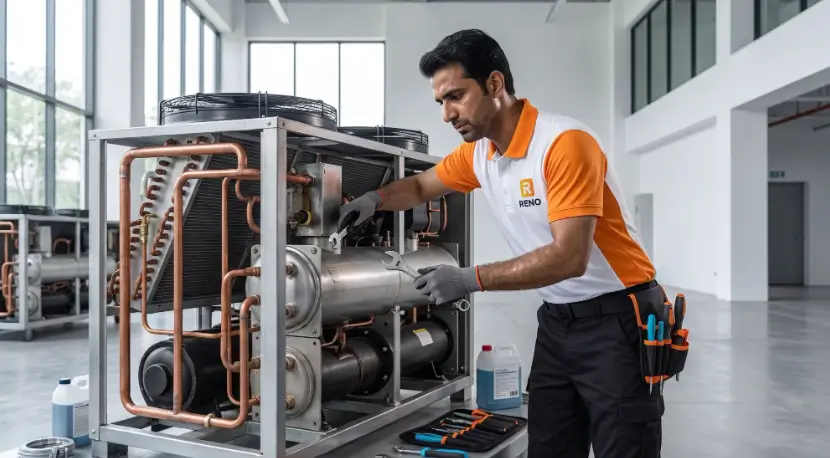
Commercial chiller efficiency is not a fixed characteristic of any piece of equipment. It is a dynamic condition that changes continuously in response to maintenance practices, operating conditions, load demands, and environmental factors. A chiller that delivered excellent efficiency at installation can be operating at thirty percent below its rated performance within two years if the factors that erode efficiency are not actively managed. Understanding what drives efficiency in commercial cooling systems, and how commercial chiller repair fits into the strategy for maintaining it, is one of the most financially significant pieces of knowledge available to any Dubai business that depends on refrigeration.
The relationship between efficiency and commercial chiller repair is direct and measurable. A chiller operating with dirty heat exchanger surfaces, a low refrigerant charge, worn compressor components, or restricted condenser airflow consumes significantly more energy per unit of cooling delivered than the same chiller in optimal condition. That energy overconsumption is the financial cost of deferred maintenance and unaddressed faults, and in Dubai’s commercial environment, where chillers run at high load for most of the year, the cumulative cost of inefficiency regularly exceeds the cost of the commercial chiller repair that would have restored performance. Just as home appliances repair in a household context is understood as a cost-saving measure rather than an expense, commercial chiller efficiency management is best understood as an investment whose return is measured in reduced energy bills and extended equipment life.
The parallel between commercial refrigeration efficiency and home appliances repair is instructive because it highlights a mindset difference that separates businesses that manage their cooling costs effectively from those that do not. Households that treat home appliances repair as a proactive rather than reactive activity keep their appliances running efficiently for longer, spend less on energy, and avoid the larger replacement costs that premature equipment failure produces. Businesses that apply the same proactive mindset to their commercial chiller systems achieve identical advantages at a scale whose financial impact is proportionally larger.
The Efficiency Factors That Determine Real-World Chiller Performance
Commercial chiller efficiency is measured in terms of the energy consumed per unit of cooling delivered, typically expressed as a coefficient of performance or an energy efficiency ratio. A new chiller installed to specification will perform close to its rated efficiency under design conditions. The factors that erode that performance over time are consistent, identifiable, and addressable, and understanding them is the foundation of any effective efficiency management strategy.
Heat Exchanger Fouling
The heat exchangers in a commercial chiller, both the evaporator and condenser, transfer heat between the refrigerant and the cooling medium. Their ability to do this efficiently depends entirely on clean heat transfer surfaces. In Dubai’s environment, condenser coils accumulate dust and particulate matter at a rate that significantly reduces airflow and heat transfer efficiency within weeks of a cleaning. Water-cooled condenser systems accumulate biological fouling, scale, and suspended solids in the condenser water circuit that increase thermal resistance on the water side of the heat exchanger. Either form of fouling forces the compressor to work harder to achieve the same cooling output, directly increasing energy consumption and accelerating compressor wear.
Evaporator fouling from oil contamination or refrigerant system contamination is less common but more damaging when it occurs, as the evaporator operates at low temperature where fouling has a proportionally larger impact on heat transfer efficiency than the same fouling level on the condenser side. Regular heat exchanger cleaning, carried out at intervals appropriate for Dubai’s environmental conditions rather than standard manufacturer schedules, is the single highest-return maintenance action available for commercial chiller efficiency management.
Refrigerant System Condition
The refrigerant circuit is the working fluid system that drives the entire refrigeration cycle, and its condition directly determines how efficiently that cycle can be completed. A refrigerant charge that has dropped below specification, a refrigerant that has been contaminated with moisture or non-condensable gases, or a refrigerant distribution system with partial restrictions all reduce the cycle’s thermodynamic efficiency in ways that show up as increased energy consumption and reduced cooling capacity before they produce any obvious operational fault.
Refrigerant system integrity checks, carried out biannually as part of a structured maintenance programme, catch these conditions while they are still inexpensive to address. A low refrigerant charge identified at a scheduled check costs a leak repair and a recharge. The same low refrigerant charge left unaddressed until it produces a compressor fault costs the leak repair, the recharge, and a compressor rebuild or replacement whose cost is typically an order of magnitude higher than the preventive intervention would have been.
Compressor Performance Degradation
The compressor is the most energy-intensive component in a commercial chiller and the one whose performance degradation most directly affects system efficiency. Compressor wear produces measurable efficiency decline before it produces operational failure, and that decline shows up in elevated current draw, reduced pressure differential across the compressor, and increased run time required to maintain set-point temperatures. A compressor that is drawing fifteen percent more current than its specification to produce the same cooling output is generating fifteen percent more energy cost while simultaneously accumulating wear at an accelerated rate.
Compressor performance assessment, carried out annually through current draw measurement and pressure differential analysis, establishes a performance baseline and tracks degradation over time. This data allows replacement to be planned and budgeted at the point where it is economically optimal rather than forced at the point of failure, which is almost always the most expensive and most disruptive timing for any major commercial refrigeration component replacement.
How Operating Conditions in Dubai Affect Efficiency
Dubai’s climate creates operating conditions that are more demanding than the design specifications of most commercial chiller equipment account for, and understanding this gap is essential for managing efficiency realistically. Chillers are designed and rated at specific ambient conditions, typically around thirty-five degrees Celsius for air-cooled condensers. When ambient temperatures exceed this design point, as they routinely do in Dubai’s summer months, efficiency declines in a predictable and quantifiable way.
Summer Efficiency Impact
An air-cooled chiller operating at forty-five degrees ambient instead of its thirty-five degree design point experiences a measurable decline in cooling capacity and an increase in energy consumption per unit of cooling delivered. This efficiency gap is unavoidable but manageable through clean condenser coils, adequate ventilation around the unit, and correct refrigerant charge that allows the system to operate as efficiently as possible within the constraints of the ambient conditions.
Part-Load Efficiency Management
Most commercial chillers operate at part load for the majority of their running hours, and part-load efficiency varies considerably between chiller types and control strategies. Modern variable speed compressor technology maintains high efficiency across a wider range of part-load conditions than fixed speed equivalents, and for businesses replacing ageing equipment, this technology difference is a significant efficiency and cost consideration in the selection decision.
Building an Efficiency-Focused Maintenance Programme
The maintenance programme that best supports commercial chiller efficiency in Dubai’s operating environment differs from standard manufacturer schedules in its frequency and its specific focus on the factors that Dubai’s climate accelerates. The following structure represents the practical content of an efficiency-focused maintenance programme adapted for Dubai conditions.
- Condenser coil cleaning every six to eight weeks rather than quarterly, to maintain heat transfer efficiency against Dubai’s dust accumulation rate and prevent the elevated head pressure that is the most direct cause of efficiency loss in air-cooled systems
- Condenser water treatment and biological fouling management for water-cooled systems, carried out continuously through a chemical dosing programme and supplemented by physical cleaning at each scheduled service visit
- Refrigerant system pressure testing and charge verification biannually, with leak detection performed before any recharge to ensure refrigerant is not being repeatedly added to a system with an unresolved leak
- Compressor current draw and pressure differential measurement at each service visit to establish performance trends and identify degradation before it reaches the level of operational fault
- Expansion valve and distribution system inspection annually to confirm that refrigerant distribution across the evaporator is uniform and that no partial restrictions are reducing heat transfer efficiency in sections of the evaporator circuit
- Controls and setpoint verification at each service to confirm that the chiller is operating at the most efficient setpoint consistent with the load it is serving, as setpoints that are unnecessarily low consume more energy without delivering any benefit to the application being cooled
When Efficiency Loss Signals a Repair Rather Than a Maintenance Issue
Maintenance addresses the gradual, progressive factors that erode chiller efficiency over time. Repair addresses the discrete component failures that produce step-change efficiency reductions and operational faults. Knowing which category a developing efficiency problem falls into determines whether the correct response is a maintenance intervention or a repair call, and making that determination correctly saves both time and money.
A chiller whose efficiency has declined gradually over several months, in parallel with increasing condenser fouling and a refrigerant charge that has drifted slightly below specification, is presenting a maintenance picture. Cleaning the condenser and restoring the refrigerant charge to specification will recover the efficiency loss. A chiller whose efficiency dropped suddenly without a corresponding change in maintenance condition, particularly one accompanied by unusual compressor noise, elevated current draw, or a significant change in operating pressures, is presenting a repair picture. The sudden change indicates a component event rather than a gradual maintenance-related decline, and a qualified technician with appropriate diagnostic equipment should assess it before further operation.
Conclusion
Commercial chiller efficiency is not a passive characteristic that either exists or does not. It is an active outcome of the maintenance practices, operating condition management, and timely commercial chiller repair that together determine how close to its rated performance any given chiller operates throughout its service life. In Dubai’s climate, where chillers work harder and environmental stresses accumulate faster than in most other markets, the gap between a well-managed chiller and a neglected one is larger and more financially significant than anywhere else. The businesses that unlock the full efficiency potential of their commercial cooling systems are those that treat efficiency management as an ongoing operational discipline rather than a reactive response to visible problems, and the maintenance programme and repair standards described in this guide provide the practical framework for doing exactly that.
Recommended:
Al Badia Residences Dubai – Area Guide
Afaf Building Bur Dubai | Location, Amenities, Lifestyle and Complete Guide
Share this article

Written by : UAE Script Staff
Follow us
A quick overview of the topics covered in this article.