
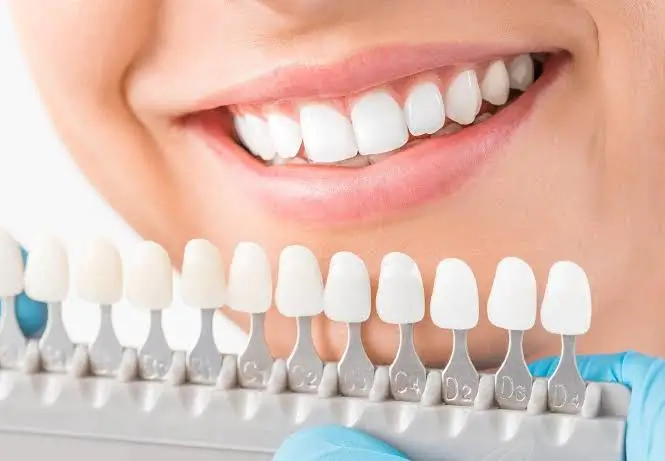
When patients go in for a consultation about veneers, they are usually already holding an opinion. Part of this opinion may have come from a cousin who had the treatment many years ago, some might be based on thirty-second reels which show a smile before and after the treatment, and a great deal of it comes from a friend who came across something online at two in the morning. Very little of what they think matches what actually takes place in the chair.
This gap does in fact cause serious problems, since people reject treatments which would have been beneficial to them or request treatments that their teeth are not suitable for; both of these situations could be avoided if patients were given better information. The following nine misconceptions regarding dental veneers are repeatedly raised in dental clinics in Dubai, and below is what the actual clinical situation is.
1. Getting veneers means shaving your teeth down to small pegs
This instance is based on photographs that are spreading online, in which the teeth have been reduced to small pointy shapes. The photographs almost always depict the stage that precedes the placement of crowns, which cover the whole tooth on all sides.
Only the front surface is treated; the preparation generally amounts to a fraction of a millimetre, about the thickness of a fingernail, and in certain instances no enamel at all is removed. The amount that is removed will depend on the position of your teeth and on the effect you are aiming for. In the case where your teeth are already fairly aligned, and you merely need correction of colour or small chips, the amount of enamel removed will be minimal. Request to see precisely how much enamel is planned to be removed and whether a more conservative approach is appropriate for your situation.
2. They are exclusively for Celebrities
People consider cosmetic work to be a luxury, which is why they think that getting dental veneers is all about appearance. However, in many cases it has nothing to do with attending glamorous events.
Patients usually ask about these dentures because they have had a front tooth chipped in a fall or a sports accident, their teeth’s edges have been worn down over the years from grinding, one tooth has become dark following root canal treatment, or they have gaps that have never closed. A person who covers their mouth in all their photographs is not being vain; they are explaining a problem which affects them every day.
3. Veneers may be used in place of braces or aligners
Veneers alter the appearance of a tooth but do not cause it to move or affect the way your teeth come together when biting. A bite problem that is not dealt with is also important later on since heavy contact on the edge of a porcelain veneer can cause it to chip.
Minor irregularities can usually be concealed quite effectively, but when the teeth are obviously overcrowded, rotated or projecting forwards, it is a different situation since in order to make a crooked tooth look straight you have to remove a great deal of enamel, much more than anyone would feel comfortable with. In such cases, treatment with clear aligners or braces initially, followed later by thinner veneers for teeth, helps to preserve more of your natural tooth. This approach takes longer, so it’s worth considering before making a decision.
4. It’s obvious to everybody to see the superficial layer.
What people notice is not the false teeth; it is a particular appearance—uniformly bright, all the same length, and with no texture or difference between one tooth and another.
Natural teeth aren’t like that. When porcelain veneers are being made, it’s possible to vary the translucency at the edges, to give the surface a subtle texture, and to match the shades not only with those of the adjacent teeth but also with the colour of your face. Many patients request to see a mock-up first, in which the intended shape is tried out directly on their teeth so that they can see it in their own mouth and ask for any changes before the final work is carried out.
5. You can whiten veneers Later
Bleaching agents act upon the natural structure of the teeth; ceramics and composites fail to respond to them.
It is important when making plans. If you are aiming for a lighter smile, the natural teeth are first bleached, the shade is then allowed to stabilise, after which the veneer shade is selected to match. If you reverse this procedure, the veneers will not blend in once the adjacent teeth have been lightened. Surface stains on composite can be removed by polishing during a hygiene appointment, even though polishing only refreshes the surface and does not alter the original colour.
6. Composite is merely a cheap imitation of porcelain
There are two different tools and two different applications. With composite veneers, the material is built up directly on the tooth during one visit, requires only a small or no amount of enamel to be removed, and can later be repaired or modified. They are appropriate for small chips, slight gaps and for patients who want a reversible solution.
Porcelain teeth veneers are manufactured in a laboratory, stain less easily and usually keep their appearance for a longer time. The choice between the two will depend on the condition of your teeth, on your habits and on the extent of change you want. The appointment numbers and the cost also differ, so it’s worthwhile asking about them at the beginning. Neither of the two options is the right one for every individual.
7. Once they’ve been turned on, dental visits become irrelevant
The other view is nearer to the truth since there is a layer on the surface of the tooth and the rest of it remains exposed to all the things it was previously exposed to.
Decay often begins at the point where the veneer comes into contact with the tooth, mostly since plaque remains in that area unchecked. When the gums are inflamed they pull back, revealing the point where the veneer and tooth meet. Protection of the veneer can be achieved through regular cleaning between the teeth, visiting the dentist for hygiene treatments and using a night guard for those who grind their teeth. One of the most common reasons why veneers need to be replaced earlier than expected is failing to keep up with regular checkups at Magnum Dental Clinic’s JLT branch.
8. It is possible to fit a veneer on any tooth
A veneer requires a solid surface to bond to; teeth that have very large old fillings, extensive decay, or a great deal of missing structure usually respond better to having a crown, since the crown holds the entire tooth together rather than just covering one side of it.
Other cases must be dealt with first. Treatment for active gum disease has to take place before any cosmetic work is carried out. Heavy grinding is generally handled as part of the treatment. Since very thin enamel makes it less certain whether bonding will succeed, the plan might have to be altered after your teeth have been examined properly.
9. One set will be good for a lifetime
Veneers for teeth are considered to be restorations, and all restorations have a service life; porcelain is able to maintain its appearance for ten years or even longer if it is well looked after, whereas composite usually requires renewing sooner.
The shape of the gums changes with time, the teeth keep on wearing down, and habits have their effect. It is intended from the beginning that they should eventually be replaced rather than seeing this as a sign that there’s been a problem. When people know this at the outset, they can make an informed decision rather than being caught by surprise years later.
Conclusion
Nearly all the myths on this list stem from evaluating a treatment according to its most extreme cases. When veneers are carried out poorly, they are noticeable, and it is precisely these that people recall. The amount you can afford to lose, an open discussion about what your teeth can endure, and a clear examination of the other available options will tell you a great deal more than any comparison photograph found online. If you are thinking about getting veneers, you should ask what amount will be removed, what the different options are, and what the situation will be like in ten years’ time. A satisfactory answer to those three questions is worth more than a hundred reels.
Contact us
- Name: Magnum Dental Clinic – JLT
- Address: Shop No. 2, Indigo Tower, Cluster D, Al Thanyah Fifth, Jumeirah Lakes Towers, Dubai, United Arab Emirates
- Phone: +971 54 452 2332
Related:
Al Quaa Milky Way Spot Abu Dhabi | Location, Best Time, Camping & Stargazing Guide
Al Safia Park Ajman | Location, Timings, Facilities, Activities & Visitor Guide
Wescott Hotel Dubai | Location, Rooms, Facilities & Complete Guide
Share this article

Written by : Barika Awad
Barika Awad is a writer at UAE Script, sharing insightful content on fashion, lifestyle, and personal style with a focus on practical, elegant ideas.
Follow us
A quick overview of the topics covered in this article.
Latest articles

October 24, 2026

October 24, 2026