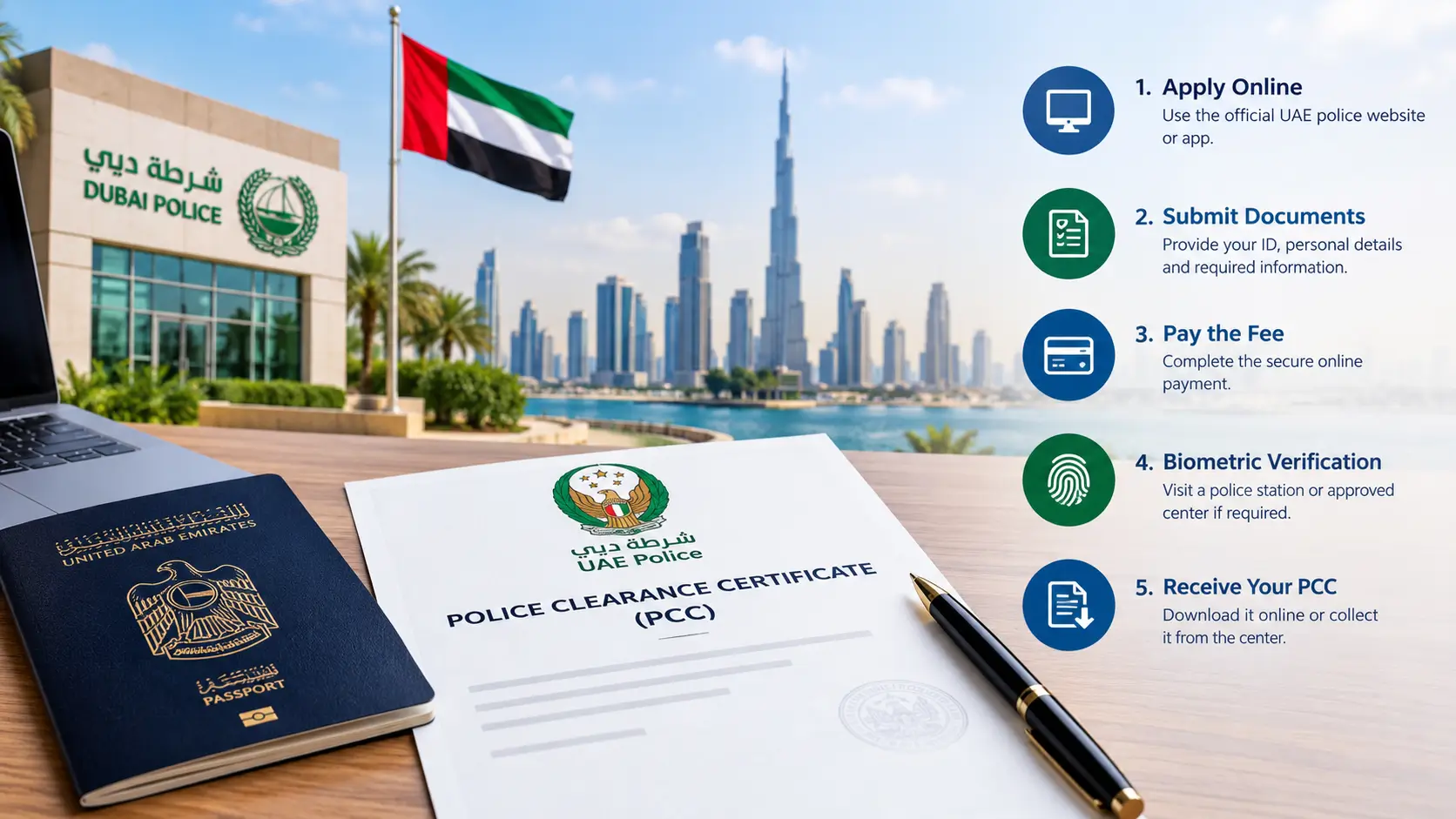
If you have spent any real time living or working in the United Arab Emirates, there is a good chance you will eventually need a Police Clearance Certificate (PCC). Officially called a Criminal Clearance Certificate—and often referred to locally as a Good Conduct Certificate—it is the government’s formal confirmation that you have a clean record with no unresolved criminal cases or convictions.
People usually find out they need this document when they are right in the middle of a major life transition: landing a new job, applying to emigrate to Canada or Australia, starting a business, or heading overseas for higher studies.
The good news? Because the UAE has linked its public services directly to your biometric profile and Emirates ID, the application is almost entirely automated. If you are a current resident with a clean record and an active UAE PASS, you can wrap up the entire process on your phone in under five minutes.
However, things get confusing when people do not know which portal to use, what to do if they already left the country, or why a foreign embassy will not accept a plain digital PDF without extra stamps. Here is a clear breakdown of how the whole system works, what it costs, and how to avoid the common snags.
What Exactly Is the UAE Police Clearance Certificate?
In plain terms, a UAE PCC confirms that you have no criminal convictions on file with federal or local law enforcement.
It is issued digitally as a downloadable PDF in either English or Arabic (or bilingual format). Every certificate comes stamped with an official electronic signature and a scannable QR code. When an employer or immigration officer scans that code, it pulls up the verified record straight from the government database, proving you did not alter or Photoshop the document.
| Feature | What to Expect |
| Issuing Bodies | Ministry of Interior (MOI) or Dubai Police General HQ |
| How Long It Stays Valid | 3 Months (90 Days) from the exact date it is issued |
| Turnaround Time | Usually 15 minutes to 24 hours (rarely longer than 48 hours) |
| Final Format | Digitally signed PDF with verification QR code |
| Primary Identifier | Your Emirates ID number (even if expired) |
When Will You Actually Be Asked for One?
You do not need to keep a PCC in your desk drawer just in case; it expires in 90 days, so you should only pull one when an authority specifically requests it. Common situations include:
-
Regulated and High-Trust Jobs: If you work in teaching, banking, healthcare (DHA/DOH/MOHAP), private security, or government departments, HR will almost certainly require one before issuing your labor contract.
-
Overseas Immigration & Visas: Foreign immigration programs (like Canada’s Express Entry or skilled migration to the UK and Australia) require police certificates for every country where you have lived for 6 or 12 consecutive months since turning 18.
-
University Admissions Abroad: Many international colleges and graduate programs require background checks before finalizing enrollment or awarding research grants.
-
Starting a Company: Certain mainland commercial activities and specialized trade licenses require business owners and partners to submit clear records.
-
Court and Civil Formalities: Adoptions, custody cases, and cross-border civil marriages frequently require clean background checks.
What Documents Do You Need?
The required documents depend entirely on whether you are currently in the UAE or applying from abroad.
If You Are Currently Living in the UAE
Because your biometric data (fingerprints and photo) is already tied to your Emirates ID in the federal database, the paperwork is minimal:
-
Your Emirates ID card number.
-
A copy of your passport and current residence visa.
-
An active UAE PASS account on your phone (this speeds up the process significantly because it auto-fills your identity).
-
A working UAE mobile number and email address to receive your confirmation code and final certificate.
If You Have Already Left the Country (Former Residents)
Applying from outside the UAE takes a bit more legwork, but you do not need to fly back to sort it out:
-
A copy of your cancelled UAE residence visa and your old Emirates ID number.
-
A clear scan of your current passport, plus the old passport you used while residing in the UAE.
-
A recent passport-style photo taken against a plain white background.
-
An Attested Fingerprint Card (if requested): If your fingerprints are too old in the federal database or cannot be pulled up automatically, you will need to walk into your local police department back home, get your fingerprints rolled onto a standard police card, and have that card authenticated by your local foreign ministry and the nearest UAE Embassy.
How to Apply: The Two Portals
The most common mistake people make is picking the wrong application channel. The rule is simple: if your residence visa was issued in Dubai, use Dubai Police. If your visa was issued in Abu Dhabi or any of the Northern Emirates, use the federal Ministry of Interior (MOI).
| Step | If Your Visa Is From Dubai | If Your Visa Is From Abu Dhabi, Sharjah, Ajman, RAK, UAQ, or Fujairah |
| 1. Where to Go | Dubai Police App or dubaipolice.gov.ae |
MOI UAE App or moi.gov.ae |
| 2. Logging In | Sign in with UAE PASS (or enter Emirates ID manually) | Sign in with UAE PASS |
| 3. Choosing Options | Pick your certificate language and select the requesting entity | Pick your certificate language and indicate your reason for applying |
| 4. Payment | Pay with a credit/debit card or Apple Pay | Pay with a credit/debit card or Apple Pay |
| 5. Getting the Document | A download link is texted and emailed to you as a PDF | The verified certificate arrives directly in your email inbox |
Method 1: Applying via the MOI Portal (Abu Dhabi & Northern Emirates)
-
Download the MOI UAE app or head to
moi.gov.ae. -
Tap Sign in with UAE PASS. Once authenticated, your legal name, nationality, and ID numbers fill in automatically.
-
Head to the Services menu and choose Police Services, then tap Issue Criminal Clearance Certificate.
-
Choose whether you want the certificate in English or Arabic. (Always choose English if this is for an international job or foreign visa).
-
Specify where the certificate is going (for instance, “Private Sector” or “Foreign Embassy”).
-
Pay the fee online. If your file is clean, the certificate is generated automatically and sent to your email, usually within a few hours.
Method 2: Applying via Dubai Police (Dubai Visa Holders)
-
Open the Dubai Police App or visit
dubaipolice.gov.ae. -
Under the Services tab, select Certificates and click on Clearance Certificate.
-
Log in with UAE PASS, or type in your Emirates ID number directly and confirm the SMS verification code sent to your phone.
-
Select the language you need and indicate whether the document will be used inside the country or abroad.
-
Settle the payment using your card or Apple Pay.
-
Check your inbox. Dubai Police’s system is largely automated, and most applicants receive their official PDF within 15 to 30 minutes.
Applying from Overseas (Step-by-Step for Former Expats)
If you left the country years ago and suddenly need a UAE police clearance for a job or visa in another country, do not panic. You can handle this remotely:
-
Dig up your old records: Look for your old Emirates ID card, visa cancellation receipt, or passport stamps to locate your old ID number and unified number (UID).
-
Try the online portal first: Go to the MOI or Dubai Police website, select the option for applicants outside the country, and type in your details. In many cases, if your biometric record is still intact, the system will process the application without asking for new physical fingerprints.
-
Get your fingerprints taken locally (only if prompted): If the portal rejects the request and asks for fresh biometrics, visit your local police station. Ask them to take your fingerprints on their standard ten-print card.
-
Get the card attested: Take that fingerprint card to your country’s foreign ministry to get it certified, and then take it to the UAE Embassy in your country for their official consular seal.
-
Upload the documents: Log back into the UAE police portal, upload the scans of your attested fingerprint card, passport, and old visa, and pay the overseas processing fee.
-
Download your certificate: Once approved, your e-certificate arrives via email. If a foreign government specifically demands a physical hard copy with wet ink seals, you can select courier delivery within the portal to have it shipped to your international address.
Fees and Processing Times
The UAE government keeps processing fees standard across platforms. However, applying in person at a counter costs more than handling it yourself online.
| Category | Typical Authority | Government Fee | Knowledge & Innovation Fees | Total Expected Cost | Standard Processing Time |
| UAE Citizen | MOI / Dubai Police | AED 100 | AED 20 | AED 120 | 1 to 4 hours |
| Current Resident | MOI / Dubai Police | AED 200 | AED 20 | AED 220 | 15 minutes to 24 hours |
| Applying From Abroad | MOI / Dubai Police | AED 300 (~$82 USD) | AED 20 | AED 320 | 2 to 5 business days |
| In-Person Application | Police Station / Service Center | Standard base fee | AED 20 | + AED 100 counter fee | Same day or next morning |
Note: Surcharges apply if you choose to visit an Amer center or customer happiness counter in person instead of completing the request through the app.
Using Your Certificate Abroad: The Attestation Process
A digital UAE clearance certificate is instantly accepted by employers and ministries inside the country. But if you are handing this document to an immigration officer in Toronto, London, or Sydney, a bare PDF might not be enough. Foreign governments often require document attestation to prove the UAE government genuinely issued the certificate.
| Step | Who Handles It | What You Must Do | The Proof You Receive |
| 1. Local Verification | UAE Ministry of Foreign Affairs (MOFA) | Upload the digital certificate to mofa.gov.ae and pay the attestation fee. |
An official digital MOFA verification sticker and barcode |
| 2. Consular Attestation | Destination Country’s Embassy (in UAE) | Submit the MOFA-attested certificate to the foreign embassy of the country you are moving to. | An official consular stamp or embossed seal |
| 3. Destination Acceptance | Foreign Immigration or Ministry | Present the fully attested document along with your visa or job file. | Final legal acceptance for your visa or residency application |
Watch the 90-Day Clock
Keep in mind that your UAE Police Clearance Certificate expires exactly three months (90 days) from the day it is generated. Do not run out and get your police clearance six months before you submit your visa application. Time it carefully so that your certificate remains valid by the time the visa officer actually opens your file.
Practical Tips to Avoid Delays
-
Clear up pending financial disputes: A PCC checks for active criminal matters. Normal parking tickets, toll balance warnings, or minor utility bills will not block your certificate. However, unresolved fraud complaints, unpaid loan default cases referred to the police, active travel bans, or pending absconding reports will freeze your application immediately.
-
Keep your UAE PASS phone number updated: The police portal relies heavily on one-time passcodes (OTPs). If the phone number tied to your UAE PASS or Emirates ID is inactive, you will get stuck at the login screen. Update your phone number in the UAE PASS app before starting.
-
Check your name spelling: If your current passport spells your name even slightly differently than your old UAE residency visa, make sure to upload a supporting page (like a government name-change deed or passport endorsement) to prevent manual review delays.
Frequently Asked Questions
1. Can I get a UAE Police Clearance Certificate without UAE PASS?
Yes. UAE PASS makes the process instant, but it is not the only option. You can enter your Emirates ID number manually on the Dubai Police or MOI portal and verify your identity through an SMS OTP sent to your registered mobile number. Alternatively, you can visit a 24/7 Smart Police Station (SPS).
2. How long does the certificate remain valid?
It is valid for three months (90 days) from the date of issue. Once those 90 days pass, the document expires, and you will need to submit a new application and pay the fee again.
3. Will unpaid traffic tickets stop me from getting my clearance?
No. Ordinary traffic fines, speeding tickets, or parking penalties do not show up on your criminal record and will not stop your certificate from being issued. However, serious traffic offenses that involve court appearances—like driving under the influence or reckless driving charges—can flag your profile.
4. What is the difference between an MOI certificate and a Dubai Police certificate?
They carry the exact same legal weight across all seven emirates and overseas. You should simply apply through the body that manages your visa: Dubai Police if your residency was issued in Dubai, and MOI if your visa came from Abu Dhabi or any of the Northern Emirates.
5. Can I apply if my residence visa is already cancelled?
Yes. You do not need an active visa to get a police clearance. You can apply using your expired Emirates ID number or your cancelled visa file number on either official portal.
6. How does an employer verify that my digital certificate is genuine?
Every certificate includes an official reference number and a scannable QR code. Anyone reviewing the document can scan the code with a smartphone camera, which immediately opens the official police database record confirming the certificate’s details.
7. Why was my application rejected or put on hold?
Applications are usually held up by one of four things: blurry document uploads, an open police complaint or unresolved financial travel ban, mismatched fingerprints in the system, or applying through the wrong portal with an unlinked visa record.
8. How quickly will I get the certificate after applying online?
If your record is clean and you use UAE PASS, the system works fast. Dubai Police often sends the certificate in 15 to 30 minutes. Applications through the MOI portal are usually processed within 2 to 24 hours.
9. Can I receive the certificate directly in English?
Yes. When filling out the form online, you can select English as your preferred language. The system generates an official English certificate, meaning you will not have to spend extra money on certified legal translation services later.
10. If I have a travel ban, will it show up on the certificate?
The certificate itself will not list your travel ban. Instead, if you have an active criminal travel ban or open court matter, the system will refuse to generate the document altogether and will direct you to contact the police or public prosecution office to resolve the underlying issue first.
Related:
How to Check UAE Visa Status Online via ICP and GDRFA Portals?
How to Recharge Salik by Plate Number? | The Complete, Hassle-Free Guide
TAMM Traffic Fine Check | How to Check Abu Dhabi Traffic Fines Online?
Share this article

Written by : Barika Awad
Barika Awad is a writer at UAE Script, sharing insightful content on fashion, lifestyle, and personal style with a focus on practical, elegant ideas.
Follow us
A quick overview of the topics covered in this article.
- What Exactly Is the UAE Police Clearance Certificate?
- When Will You Actually Be Asked for One?
- What Documents Do You Need?
- How to Apply: The Two Portals
- Applying from Overseas (Step-by-Step for Former Expats)
- Fees and Processing Times
- Using Your Certificate Abroad: The Attestation Process
- Practical Tips to Avoid Delays
- Frequently Asked Questions
- 1. Can I get a UAE Police Clearance Certificate without UAE PASS?
- 2. How long does the certificate remain valid?
- 3. Will unpaid traffic tickets stop me from getting my clearance?
- 4. What is the difference between an MOI certificate and a Dubai Police certificate?
- 5. Can I apply if my residence visa is already cancelled?
- 6. How does an employer verify that my digital certificate is genuine?
- 7. Why was my application rejected or put on hold?
- 8. How quickly will I get the certificate after applying online?
- 9. Can I receive the certificate directly in English?
- 10. If I have a travel ban, will it show up on the certificate?