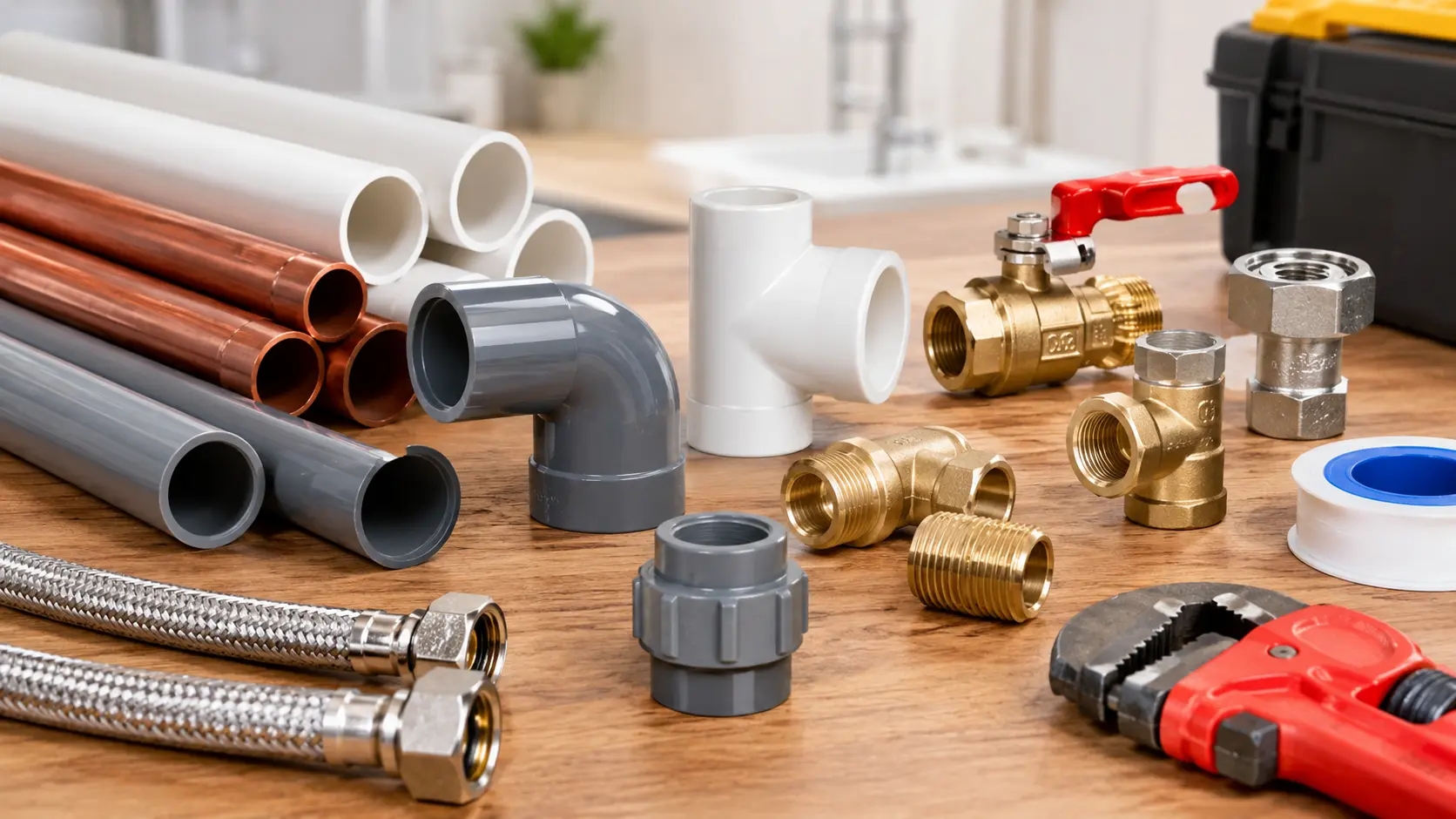
Pipes get most of the attention, but fittings do most of the work. Every change in direction, branch connection, pipe size transition and shut-off point in a plumbing system requires the right component and fittings are also where leaks most often start. Knowing the names, functions and materials of different fittings saves time when buying plumbing supplies and avoids discovering a mismatched part halfway through a job.
Common Fittings and What They Do
Elbows
Elbows change the direction of a pipe run, most often by 90 or 45 degrees. On drainage lines, long-radius or “sweep” elbows are preferred because the gentler curve keeps waste moving and reduces the chance of blockages.
Tees and Wyes
A tee splits one line into two, or joins two into one. Equal tees have the same diameter at all three connections, while reducing tees have a smaller branch connection. On drains, a wye (a Y-shaped branch) is used instead, because its angled branch feeds waste into the main line in the direction of flow instead of at a right angle.
Couplings
The simplest fitting of the lot: a short sleeve that links two straight pipes end to end. A standard coupling has a stop in the middle, so each pipe seats exactly halfway. Slip couplings, also called repair couplings, leave that stop out. The whole sleeve can be pushed along the pipe and then slid back over the gap, which means a cracked section can be fixed by cutting out only the damaged piece.
Unions
A union does the same basic job as a coupling, with one important difference: it comes in three parts, and the central nut lets the joint be taken apart without cutting the pipe. That’s why unions go next to equipment that will eventually need servicing or replacing, such as water heaters, pumps, filters and meters.
Reducers and Bushings
Both deal with a change in pipe diameter. A reducer sits between a larger pipe and a smaller one, tapering from one size to the other. A bushing fits into an existing fitting and brings its opening down to a smaller size, which makes it handy where space is tight.
Adapters
Whenever two parts of a system don’t match, whether in material or in the type of end, an adapter bridges the gap. A typical example is a plastic pipe that has to connect to a threaded tap or valve outlet. Male adapters carry the thread on the outside, female adapters on the inside.
Caps, Plugs and Nipples
Caps and plugs both seal off a line, usually one that is out of use or will be extended later. The difference is where they go: a cap fits over the end of the pipe, a plug fits into an opening. Nipples do the opposite job. These short pieces of pipe, threaded at both ends, join two female fittings that sit almost back to back.
Valves
Valves are technically a category of their own, but hardly any plumbing job gets done without them, so they usually end up on the same order list as the fittings. Ball valves shut off the flow with a quarter turn of the handle. Gate valves are often found on the main supply line. Check valves let water travel in one direction only, which is essential on pump and tank connections. Angle valves, fitted behind sinks and toilets, let you isolate a single fixture while the rest of the house keeps its water supply.
How Fittings Connect
The type of connection largely depends on the pipe material:
- Solvent weld: PVC and CPVC, bonded permanently with primer and solvent cement.
- Threaded: brass, galvanised steel and threaded plastic adapters, sealed with PTFE tape or thread sealant.
- Compression: a nut and ring (olive) clamp onto the pipe; common on brass fittings for taps and appliances.
- Heat fusion: PPR pipe and fittings, melted together with a fusion tool into a single piece.
- Soldered or pressed: copper systems.
- Push-fit: quick to install and handy for repairs, though more expensive per joint.
Fitting Materials
PVC
PVC fittings are light, inexpensive, corrosion-proof and easy to join without special tools. They are the standard choice for cold-water supply, drainage, irrigation and tank overflow lines. A typical range of PVC plumbing fittings covers almost any layout, from basic elbows and tees to cleanout plugs and threaded adapters for connecting to metal outlets.
PVC has two main limitations: it isn’t suitable for hot water, and prolonged exposure to direct sunlight can make it brittle. On UAE rooftops, where tanks, overflow lines and pipe runs sit in full sun for most of the year, this happens faster than many people expect. Exposed runs on rooftops and outdoor walls should be shielded or painted with a suitable coating.
CPVC and PPR
CPVC is a chlorinated form of PVC that handles higher temperatures, so it can carry hot and cold water. PPR is joined by heat fusion, leaving no glued or threaded joint inside the wall, and it is widely used for hot and cold supply in modern residential buildings.
Brass
Brass is a strong copper-zinc alloy that’s easy to machine into precise threads and performs well under heat and pressure. Even all-plastic systems rely on it wherever the pipework meets equipment or a fixture. That’s why brass fittings turn up at almost every water heater, pump, meter, mixer and stop valve, as well as in compression joints and plastic-to-metal transitions.
In areas with chemically aggressive water, standard brass can gradually lose zinc through a process called dezincification, which can leave the fitting porous. Dezincification-resistant (DZR) brass is made to avoid this and is worth specifying for concealed or hard-to-reach joints.
Copper and Galvanised Steel
Copper fittings are durable and handle hot water well, but joints need soldering or a press tool, and material costs are high. Galvanised steel is now mostly found in older buildings, where internal rust gradually narrows the bore and reduces water pressure.
Choosing the Right Fitting
Before buying, it helps to check a few things:
- Pipe material and size. Sizing systems differ between PVC, PPR and copper, so a fitting must match both the material and the actual pipe diameter.
- Pressure and temperature. Hot lines and pump outlets need fittings rated for those conditions.
- Access. Where a joint may need to come apart later, use a union or threaded connection rather than a permanent one.
- Mixed metals. Joining copper directly to galvanised steel causes galvanic corrosion; a proper transition fitting prevents it.
- Exposure. Sunlight, burial and outdoor heat all affect which material will last.
It’s also worth picking up a few spare elbows and couplings. They’re inexpensive, and having to stop work because you’re missing a small fitting can be frustrating.
Related:
Ejari (Dubai) vs. Tawtheeq (Abu Dhabi) | The Ultimate UAE Rental Guide
Share this article

Written by : Barika Awad
Barika Awad writes for UAE Script, specializing in UAE finance and lifestyle content — from bank services to visa and residency guides. She's passionate about making official processes easier to understand for expats and residents alike.
Follow us
Latest articles
October 22, 2026

October 22, 2026