
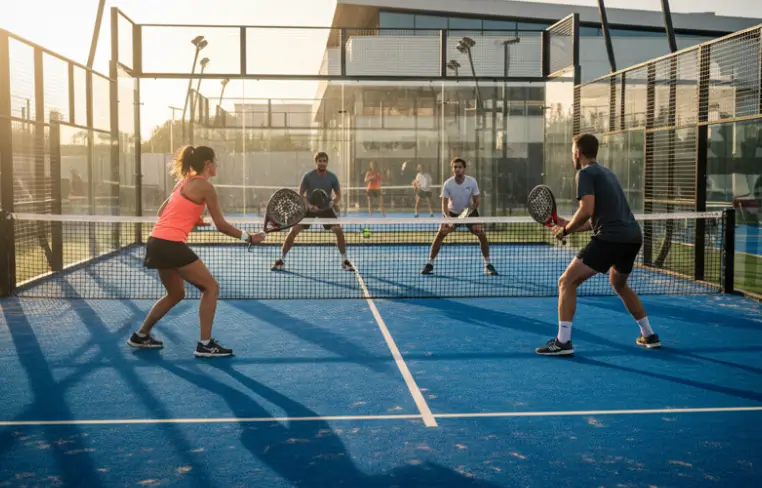
If you’ve recently walked past a local sports club and heard the rhythmic “pop” of a ball hitting a solid racket followed by bursts of laughter, you’ve likely encountered the world’s fastest-growing racket sport. You might be asking yourself, what is padel tennis, and why has it suddenly become the new obsession for athletes and social seekers alike?
Often described as a high-energy mix between tennis and squash, this padel sport is social, fast-paced, and incredibly easy for beginners to learn. Whether you are a seasoned athlete or just looking for a fun way to spend your padel time, this guide will walk you through the rules, the equipment, and the unique dynamics of this addictive padle game.
Understanding the Basics: Is it Padel or Paddle?
There is often a bit of linguistic confusion when people first discover the sport. You might see it spelled as padle or referred to broadly as paddle tennis. While they share historical roots and similar phonetic sounds, “Padel” (with an ‘e’) is the specific global phenomenon played on an enclosed glass court.
The sport originated in Mexico in the late 1960s and exploded in popularity across Spain and Argentina before taking over the rest of the world. Regardless of the spelling used in your local neighborhood, the heart of the game remains the same: a high-energy doubles match that keeps you on your toes and provides a full-body workout without the steep learning curve of traditional tennis.
The Arena: Padel Court Size and Features
One of the first things you’ll notice that differentiates this from other sports is the unique environment. The standard padel court size is 20 meters long by 10 meters wide. To put that into perspective, it is roughly 25% smaller than a traditional tennis court, which creates a much more intimate and fast-chewing gameplay experience.
The most defining feature, however, is the enclosure. The court is surrounded by walls made of high-impact tempered glass and metallic mesh. Unlike tennis, where a ball hitting the back fence ends the point, in padel, the walls are your best friends. As long as the ball bounces on the turf first, it can hit the wall and remain in play. This allows for creative “boast” shots (hitting the ball into your own glass to get it over the net) and incredible tactical recoveries that simply aren’t possible in other sports.
Essential Equipment: What You Need to Play
To get started with this padel sport, you don’t need an expensive gear bag, but the equipment is very specific:
- The Racket: Unlike tennis rackets, padel rackets are stringless. They are thick, solid, and perforated with holes to reduce wind resistance. Usually made of carbon fiber or fiberglass with a foam core, they offer a “pop” that feels very satisfying upon contact.
- The Ball: At a glance, padel balls look identical to tennis balls. However, they have slightly less internal pressure. This makes them a bit slower and less “jumpy,” which is necessary to keep the ball within the smaller padel court size.
- The Shoes: Since the game involves a lot of lateral movement and pivoting on artificial turf (often layered with a fine coat of sand), shoes with a herringbone or “clay court” grip are essential to prevent slipping.
How to Play: Mastering the Rules
The beauty of this padle game lies in its simplicity. While the professional matches look incredibly complex, the basic mechanics are easy to grasp in under ten minutes.
The Underhand Serve
In paddle tennis, all serves are delivered underhand. This immediately removes the “power serve” advantage seen in tennis, making the game more about strategy than raw strength. You must bounce the ball once behind the service line and strike it at or below waist height. The ball must land diagonally in the opponent’s service box. A key rule to remember: if the ball hits the wire fence after the bounce on a serve, it’s a fault; however, if it hits the glass wall, the serve is perfectly legal
Gameplay and the “Wall” Rule
A point continues as long as the ball stays in play without bouncing twice on one side. The golden rule is that the ball must always hit the ground on the opponent’s side before hitting a wall. Once it bounces, the opponent can let it hit the glass and then return it, or hit it back immediately. This “second chance” off the glass is what makes the game so accessible, even if you aren’t the fastest runner, you can use the bounce off the back wall to buy yourself more padel time.
The Scoring System Explained
If you’ve ever played a set of tennis, you already know how to keep score in padel. It follows the traditional format:
- 15, 30, 40, and Games.
- Deuce: If the score reaches 40-40, it is called a deuce. In most club games, you play for “Advantage,” meaning one team must win two consecutive points. However, many professional circuits and “fast-play” formats use the Golden Point, a sudden-death point where the receiving team chooses the side, and the winner of that single point takes the game.
- Sets and Matches: Matches are typically played as the best of three sets. A set is won by the first team to reach six games, provided they have a two-game lead. If the score reaches 6-6, a 7-point tie-break is played.
Why It’s Always a Doubles Game?
You will rarely, if ever, see a professional singles paddle match. Padel is fundamentally designed to be a social experience, played exclusively in a 2v2 format. Because the court is compact, having four players ensures the game stays fast-paced and strategic.
It requires constant communication with your partner, calling for balls, deciding who takes the middle, and shifting together like a pendulum. This collaborative element makes it a fantastic team-building activity and a great way to meet new people at your local club.
Pro-Tips for Your First Match
- Don’t Smash Everything: Beginners often try to power the ball past their opponents. Because of the glass walls, a hard shot often bounces right back to the defender at a comfortable height.
- The Lob is King: The lob is arguably the most important shot in the padle game. A high lob forces your opponents away from the net and gives you and your partner time to take the offensive position.
- Patience Pays Off: Take your padel time. Wait for the right ball to attack rather than forcing a winner from the back of the court.
Related:
Share this article

Written by : Barika Awad
Barika Awad writes for UAE Script, specializing in UAE finance and lifestyle content — from bank services to visa and residency guides. She's passionate about making official processes easier to understand for expats and residents alike.
Follow us
A quick overview of the topics covered in this article.