
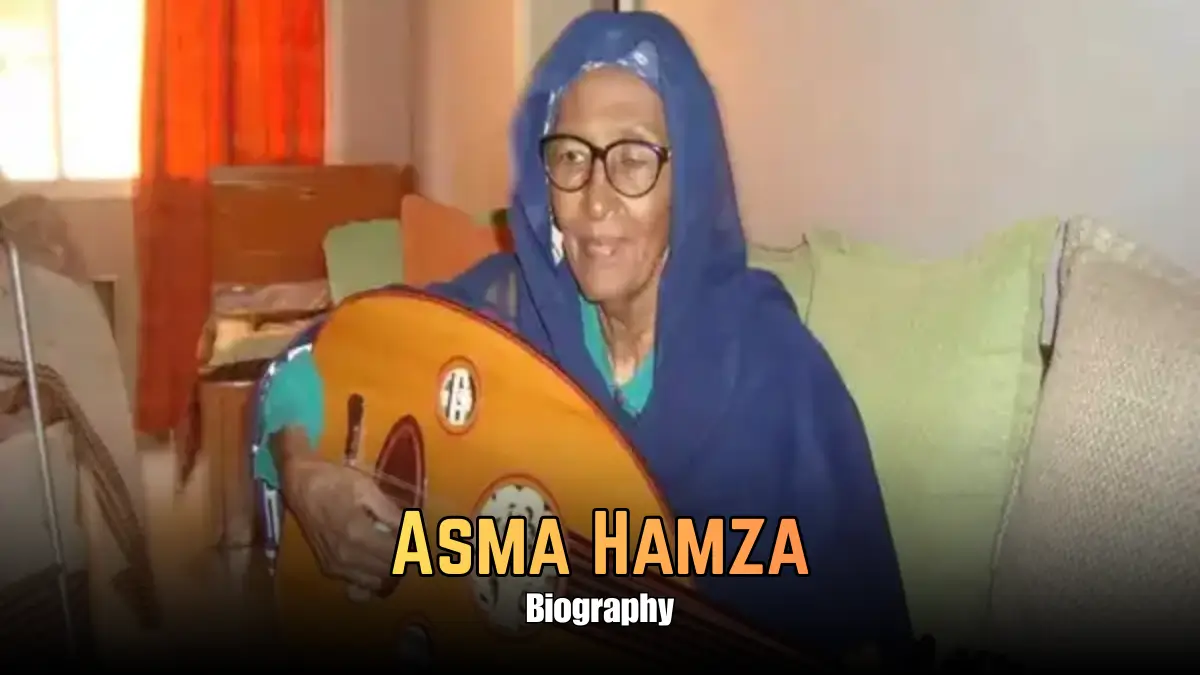
One of the brightest names of Arabic music is Asma Hamza. She symbolizes the originality, determination, and the destruction of boundaries. She has created a potent tale of strength and genius that few musicians, more so women of her time, could throw themselves with as she is celebrated globally and recently honored with a Google Doodle.
This is a detailed biography covering her early years, her work, her contribution, personal life, her challenges, and her legacy to the world which provides a clear and an inspiring story which not only increases search relevance.
| Category | Details |
|---|---|
| Full Name | Asma Hamza Bashir |
| Born | 1932, Halfaia, Sudan |
| Family | Only child |
| Early Interest | Interested in music, played oud |
| Education | Self-taught, no formal music education |
| First Instrument | Oud (string instrument) |
| Career Start | Self-taught, started composing in secret |
| Breakthrough | Won Laylat al-Qadr Al-Kubra (1997) |
| Key Work | Composed ‘Al Zaman Al-Tayb’ (1983) |
| Awards | Google Doodle tribute (2023) |
| Challenges | Fought gender bias, music in secrecy |
| Legacy | Pioneer for women in Arab music, inspired generations |
Early Life and Background
Birth and Family Origins
Asma Hamzy Bashir was born in Halfaia Al-Malaki, Sudan in 1932. Her family were musically exposed and oral practices were common in the lives of the family. This environment fostered her instinctive sense of rhythm and premature interest in sound. She had been an only child to her parents and subsequently, a mother who left behind a daughter.
Cultural and Social Influences
At the beginning of the 20th century and the middle part of the 19 century, Sudan was a socially conservative state, particularly with respect to the role of women. There was a lot of male dominance in music especially in the composition and performance. The early exposure to oral tradition and telling of cultural stories, however, was the pathway to her future. She was surrounded by fertile melodies of landscapes, both traditional Sudanese melodies and Arabic classical tunes, which added up to the compositions.
Schooling and Music Self-Discovery
Hamza was also self-educated in music, contrary to many other musicians of the time. She built up on her talents which were ear training, practice, and experimentation. She learned to play the oud which is a stringed instrument like the lute by listening and remembering.
Childhood Problems and Early Music Interest
Asma had a dream of being a singer when she was a child. She found that her voice could not produce the sounds of a professional singer and so she started whistling instead. Her father realized that she had talent and unlike in the past, he encouraged her interest and provided her with an oud.
Youthful Career and Music Breakthrough
Between Whistling and Oud Playing
Asma did not give up in spite of social opposition. She learned oud through listening and practicing and after some time, she could know complex melodies by heart. The oud (Arabic: عود) is a traditional instrument of the Middle East making use of a string that has a deep and resonant quality and is a standard instrument in traditional Arabic music.
Nurse Training and Early Notice
Asma was one of the first women in Sudan to get formal training in oud in 1946, paving the way to her being hailed as a pioneer artist.
First Composition and Secret Beginnings
Her debut song, Ya Ouyouni, was a tune to a poem by an Egyptian poet Ali Mahmoud Taha in 1956. Since the writing of music was not the norm of women, she concealed the music. However, it won the respect of colleagues and well-known musicians as she perfected her voice and her art.
Read More: Ramneek Sidhu Biography
Success to Power and Influence
Turning Point: Laylat al-Qadr Al-Kubra Competition
One of the starring events was the purchase of the national music competition Laylat al Qadr Al Kubra in 1997 by Asma. The victory made her enter the world of fame and she established herself in a male-dominated musical society.
The Composition of Melodies to the Arab Musical World
Hamza was an early female composer in Sudan and the Arab world at large, as she grew up writing several melodies to Arab artists. She combined the elements of the Sudanese with the Arabic lyrical traditions in her work, creating compositions that were emotionally evocative and culturally very resonant.
Partnerships and Music History
Her music also overlapped with compositions of prominent poets and performers throughout the Arabic world. She wrote more than 90 songs, the most famous of which was the song titled Al Zaman Al-Tayb to a poem by Saifeddine El-desouki and was performed by the Sudanese singer Summer Hassan in 1983. Her music was acclaimed as high-quality emotionality, melodic creativity, and cultural amalgamation.

Personal Life and Values
Family and Support System
Asma had a very important role in her family, particularly her father, to help her with her early musical ambitions in a period where female musical expression was limited. This support made her struggle against social forces. She later developed as a mother and managed to maintain a balance between family and her career as an artist.
Philosophy of Music, Beliefs, and Values
Hamza considered music as a language of feeling that was beyond the social conventions and gender restrictions. She thought that the oud had a rich culture that had the potential to bring people of different cultures together. Her zeal for music came as a result of passion, genuineness, and a wish to hold on to the culture or heritage.
Musical Influences
Among the influences were Egyptian icons to whom she was influenced, like Umm Kulthum, Mohamed Abdel Wahab, Abdel Halim Hafez, and Shadia, whose compositions influenced and inspired her.
Challenges and Struggles
Breaking Gender Barriers
It was a rare occurrence that a female composer and instrumentalist existed in mid-20th century Sudan. Not only did she have to struggle with the resistance of society, gender prejudices, and culture, but she had to secretly compose her first piece. But she took the challenges as a means of generating creativity and received admiration even outside her own community.
Resilience and Tenacity
This was an exceptional case of her resilience in a conservative context. She put battles into music, and she produced a voice that transcended the boundaries and left women musicians of her age to dream and hope that more would come.
Public Reception
Being rather doubtful at first, the audience came to respect her as a pioneer, icon of artistic persistence, and musical innovator.
Awards, Honors, and Recognition
National and Cultural Honors
There have been a few official honors outside of the Laylat al Qadr win, and the 2023 Google tribute is a major international accolade on her music and cultural work.
Google Doodle Tribute
Google honored Asma Hamzy with a special doodle on July 17, 2023, to remember her contribution to music, gender equality, and her contributions as a cultural icon. This was known to millions of people across the globe.
Sudanese and Arab Traditions in Music
She is still universally considered as one of the earliest women composers and professional trained oud players in Sudan and the Arab world, which is a historic milestone in a male-dominated profession.
Later Years and Passing
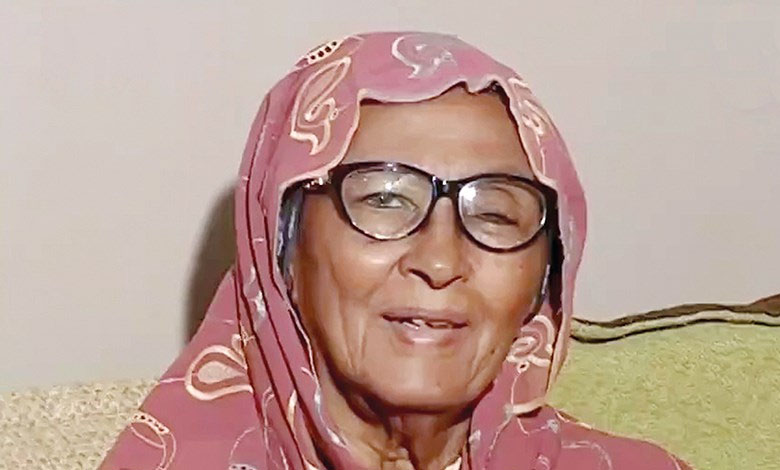
Asma still taught young musicians and sharpened her skills until her passing on May 21, 2018, at her home in Halfaia. Her death was not only grieved throughout the Sudanese cultural circles but it also was a celebration of the end of one of the most influential musical personalities in Sudan.
Impact and Legacy
Impact on Future Generations
The legacy left behind by Hamza is not just her compositions but also her opening up the path to women in Arab music. She has demonstrated that it is possible to cross profound social boundaries by using talent, courage, and perseverance.
Cultural Significance
Her songs remain to be a mixture of Sudanese beats and Arabic tunes that she connects the sense of identity and art.
Lasting Recognition
The global attention and Google Doodle in her honor is proof of her timelessness as an icon to musicians and music fans across the globe.
Conclusion
The life of Asma Hamza is full of passion, perseverance, and innovativeness. Halfaia Al-Malaki came out of a tiny village of Halfaia and made social and cultural waves, creating her mark in the Arabic musical history. She demonstrated that music is not only individual and personal, but also a cultural revolution—a legacy that would fuel musicians, women, and dreamers even generations after.
Related:
Share this article

Written by : Barika Awad
Barika Awad writes for UAE Script, specializing in UAE finance and lifestyle content — from bank services to visa and residency guides. She's passionate about making official processes easier to understand for expats and residents alike.
Follow us
A quick overview of the topics covered in this article.